
What Machine Do I Need to Break Rock or Concrete?
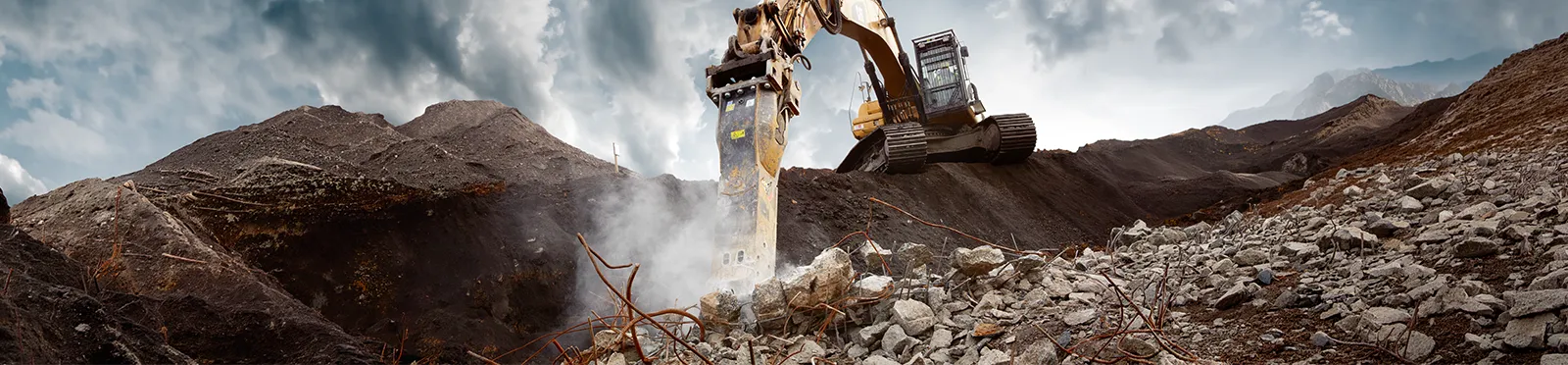
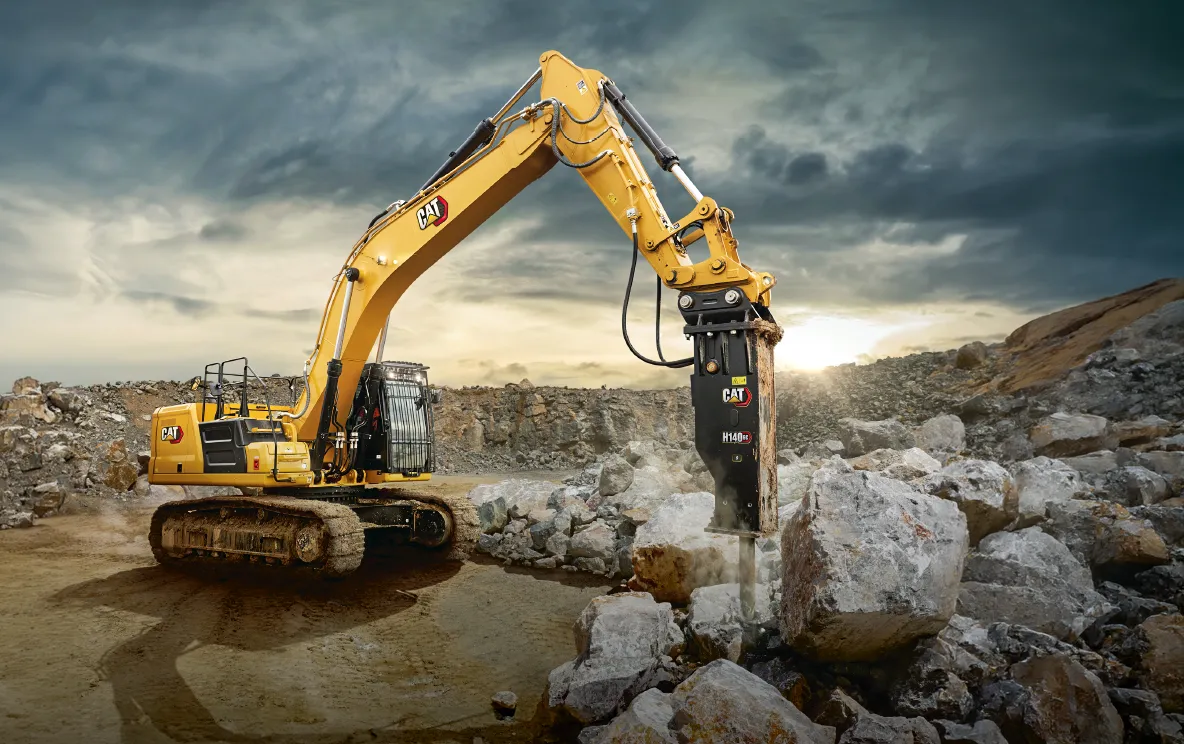
To break rock or concrete on a plot, fit a hydraulic hammer to an excavator sized for the job. For a few cubic metres of caprock or an old slab, a hammer on a mini excavator, backhoe or skid steer is enough. For foundations and trenches in hard rock, use a 20 t excavator with a Cat H120 GC hammer. For large areas of rock that can be ripped, a dozer with a rear ripper is faster than any hammer.
Hammer or ripper?
Hammer
Breaks rock in one spot. Best for trenches, footings, pits, boulders and concrete. Works in tight spaces.
Ripper
Pulls a ripper tooth through the ground behind a dozer. Best for large areas of rock weak enough to crack along layers. Fast over big areas, useless in a trench.
Many quarry and road jobs use both: rip what rips, hammer what does not.
Which hammer fits which machine?
A hammer must match the carrier's weight and hydraulic flow. Too small and it breaks slowly. Too big and it strains the machine.
| Cat hammer | Carrier weight (Cat) | Typical carrier |
|---|---|---|
| B6 | From 3,629 kg | 4-9 t mini excavators, skid steers and track loaders, 415-444 backhoe loaders |
| B8 | From 6,350 kg | 6-9 t mini excavators, skid steers and track loaders, 415-444 backhoe loaders |
| H110 GC | 11-16 t | 12-15 t excavators |
| H115 GC | 13-18 t | 14-17 t excavators |
| H120 GC | 18-30 t | 20 t class, Cat 320 and 320 GC |
| H140 GC | 30-40 t | 30-36 t class, Cat 330 and 336 |
| H160 GC | 33-45 t | 36-40 t class |
| H180 GC | 40-55 t | 45-50 t class |
How do I choose the size?
Ask three questions:
How hard is it?
Weak caprock and old concrete break with a small hammer. Hard limestone or basalt needs a bigger one.
How much is there?
A slab or a few boulders is a small job. Trenches through rock for a whole site need a larger carrier and hammer, or the job takes weeks.
How much space?
In a villa plot or next to buildings, a mini excavator or backhoe with a B hammer fits. On open ground, go bigger.
What about breaking concrete?
For slabs, footings and small walls, a hammer works. For demolition of whole structures, a pulveriser or multi-processor on an excavator is quieter and separates rebar from concrete.
Cat sells pulverisers and multi-processors as well as hammers. Ask us which tool suits your demolition job.
When does a dozer with a ripper win?
When rock covers a large area and cracks along layers, a ripper moves far more material per hour than a hammer. A Cat D8 handles medium rock. A Cat D9 is built for hard rock and quarries.
Our D6 vs D8 vs D9 guide has the sizes. If the ripper only scratches the surface, the rock is too hard to rip and you need hammers or blasting.
FAQ
Can a backhoe loader carry a hammer?
Can I put a hammer on a skid steer?
How noisy is a hammer?
Do hammers need special maintenance?
Can I rent a hammer?
Next step:
Send us the material (rock or concrete), rough volume, the machine you have or need, and the site on WhatsApp or through the form. Our team replies within 1 working day with the right hammer and carrier and a written quote.
